
Signs Your AHU Blower Fan Needs Retrofitting Before It Costs You More in Repairs
Most facility managers don't think about their AHU blower fan until it stops behaving. It runs in background day after day. Moving conditioned air through your building without asking for much attention. Then one day, electricity bill looks off. Or sound coming from the plant room changes. Or a repair that should've taken an hour drags into a full day of troubleshooting.
Here's the thing - by the time AHU blower fan announces its problems loudly, it's usually already cost you more than a timely retrofit would have. Catching the early signs of an ageing AHU fan isn't about being paranoid. It's about reading the signals your equipment is already giving you, the same way you'd track any other OPEX expense quietly chipping away at your budget.
This blog from Wired and Wireless will walk through exactly what those signals look like. So you can decide whether it's time for an AHU fan retrofit before repair bills start piling up.
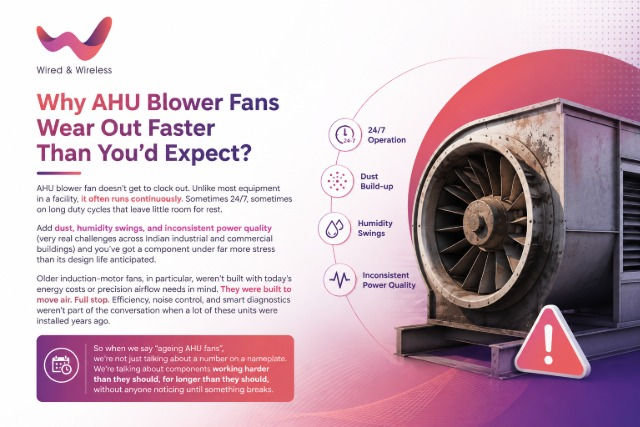
Why AHU Blower Fans Wear Out Faster Than You'd Expect?
AHU blower fan doesn't get to clock out. Unlike most equipment in a facility, it often runs continuously. Sometimes 24/7, sometimes on long duty cycles that leave little room for rest. Add dust, humidity swings, and inconsistent power quality (very real challenges across Indian industrial and commercial buildings) and you've got a component under far more stress than its design life anticipated.
Older induction-motor fans, in particular, weren't built with today's energy costs or precision airflow needs in mind. They were built to move air. Full stop. Efficiency, noise control, and smart diagnostics weren't part of the conversation when a lot of these units were installed years ago.
So when we say “ageing AHU fans”, we're not just talking about a number on a nameplate. We're talking about components working harder than they should, for longer than they should, without anyone noticing until something breaks.
Our Full Range of Energy Solutions
Before we get into the signs, worth noting - retrofitting an AHU fan is one piece of a bigger energy efficiency picture. Wired and Wireless works across Industrial AHU blower fans and HVAC solutions as well as rooftop solar power systems and our full range of services is outlined here if you're evaluating facility-wide energy savings rather than just the fan.
What Are AHU Blower Replacement Signs You Shouldn't Ignore?
Some of these signs show up gradually. Others show up all at once. Either way, they're worth paying attention to.
Rising Energy Bills With No Real Explanation
If your electricity costs have crept up and nothing else in the building has changed, your AHU fan is a good place to look. Ageing motors lose efficiency over time - bearings drag, windings degrade, and the fan ends up drawing more power to do the same job it used to do more cheaply.
Unusual Noise or Vibration From the Blower
A healthy fan has a fairly consistent sound signature. Grinding, humming that wasn't there before, or a rattle that seems to come and go are all worth investigating. Under the ISO 10816-3 standard, which provides criteria for evaluating machine vibration based on measurements taken at bearings and housings, even small increases in vibration amplitude can point to bearing wear long before a fan actually fails.
It's also worth knowing that noise and instability aren't always a hardware problem. Engineered Systems, a publication of ACHR News, recently reported on air handling units where the return and supply fans end up fighting each other due to a control sequence issue, leading to alarms and unstable fan operation that can look identical to a failing blower. If a fan is misbehaving, it's worth ruling out controls before assuming the hardware itself is at fault - but persistent vibration on an older fan is still one of the clearest ageing signals you'll get.
Inconsistent Airflow Across Zones
Are some areas of your facility harder to cool than others, even though nothing structural has changed? Uneven airflow often traces back to a blower that's no longer delivering consistent output, whether from blade wear, motor slippage, or a fan that's simply undersized for current demand.

Frequent Bearing or Belt Failures
One bearing failure is a maintenance event. Three bearing failures in eighteen months is a pattern. Research published by Oxmaint notes that vibration analysis is the most widely used predictive maintenance technique for catching bearing faults in industrial fans before they escalate into full failures.
If your team keeps replacing the same components on same fan, fan itself - not the parts - is usually the real problem.
Fan Runs Noticeably Hotter Than It Used To
Touch-testing isn't a precise method. But a maintenance team that knows their equipment will notice when a motor housing runs warmer than normal. Heat is wasted energy. And in a fan, it's often an early indicator of internal friction or electrical inefficiency.
Increased Downtime for Minor Repairs
Every fan needs occasional maintenance. But if minor repairs are happening more often, taking longer, or requiring specialist call-outs that used to be routine in-house fixes, underlying equipment has likely crossed from maintainable into failing gradually.
Fan Predates Modern EC Motor Technology
If your blower fan is still running on a standard induction motor with no variable control, it's already behind where fan technology has moved. Electronically commutated (EC) fans deliver meaningfully better efficiency and finer airflow control - something we've covered in more depth in our piece on VFD for AHU systems. It explains how variable-speed control changes the energy equation entirely.
Difficulty Sourcing Spare Parts
When a fan model is old enough that your maintenance vendor is scrambling to find replacement parts, or worse, suggesting fabricated substitutes, that's a structural warning sign. It means every future repair is going to be slower, costlier, and less reliable than the last.
Retrofit or Replace? Why Retrofitting Usually Wins
Here's a question we get a lot: If the fan is old, why not just replace the whole AHU?
In most cases, that's overkill. AHU housing, ductwork, casing - they are often still structurally sound. It's the blower fan and motor assembly that's dragging performance down. Retrofitting the fan itself rather than replacing the entire unit is typically faster to install, less disruptive to operations, and considerably cheaper.
Theory? It isn’t just about that. Modern Building Services magazine documented a case where a UK leisure centre's air handling units (some of which had been running for 30+ years) were upgraded through a plug-fan retrofit rather than a full AHU replacement. Delivering the energy savings the facility was after without tearing out existing infrastructure. That's the same logic that applies to fabs, hospitals, and manufacturing plants here - you fix the component doing the damage, not the whole system.
The U.S. Department of Energy notes that dramatic energy and cost savings can be achieved in motor systems by applying best energy management practices and installing energy-efficient equipment. And a fan retrofit is exactly that kind of targeted, high-impact upgrade.
What Happens If You Wait Too Long?
Delaying a retrofit doesn't freeze the problem in place. It compounds it.
A fan running inefficiently keeps costing you extra on every single electricity bill until it's replaced - that's money that never comes back. Bearing wear that goes unaddressed eventually leads to a full seizure, which usually means unplanned downtime instead of a scheduled retrofit window.
And in regulated environments like hospitals or pharma facilities, inconsistent airflow can eventually become a compliance issue, not just an efficiency one.
The math is fairly simple: planned retrofit costs less, disrupts less, and happens on your schedule. A reactive replacement after failure costs more, disrupts more, and happens on the fan's schedule - usually at the worst possible time.
How Wired and Wireless Approaches AHU Fan Retrofitting?
We've spent over a decade working on AHU blower and extraction fan retrofits for hospitals, pharma units, and manufacturing facilities across India. Through our partnership with Novenco - global leader in cleanroom and industrial ventilation technology, we bring in EC fan solutions engineered specifically for continuous, high-demand environments. Not off-the-shelf fans adapted for the job.
One recent example: a multi-specialty hospital in Mumbai partnered with us for an AHU blower replacement and saw savings of over 66% on the fan's energy consumption after retrofitting with a Novenco ZerAx fan. You can read the full breakdown in our hospital AHU fan case study.
So Is It Time for an AHU Fan Retrofit?
If you're nodding along to two or more of these, it's worth getting a site assessment:
Energy bills have risen without a clear cause
New or worsening noise/vibration from the blower
Airflow feels inconsistent across zones
Repeated bearing, belt, or motor repairs
The fan runs hot to the touch
Repairs are taking longer or happening more often
The motor is a standard induction type, not EC
Spare parts are getting harder to find

Frequently Asked AHU Fan Blower Retrofitting Questions
How long does an AHU blower fan typically last before needing a retrofit?
It varies by duty cycle and environment, but most industrial AHU fans start showing efficiency losses and mechanical wear somewhere between 8-15 years of continuous operation. Facilities running fans 24/7 in dusty or humid conditions often see signs earlier.
Is retrofitting cheaper than replacing entire AHU?
In most cases, yes. Since the AHU housing and ductwork usually remain functional, retrofitting just the fan and motor assembly avoids the cost and disruption of replacing the full unit.
Can I retrofit an AHU fan without shutting down operations for long?
Retrofit timelines depend on facility size and access, but planned retrofits are almost always faster and less disruptive than emergency replacements after a fan failure.
Do EC fans really save that much energy compared to older motors?
Yes. EC fans use variable-speed control to match output to actual demand, rather than running at a fixed speed regardless of need. Real-world retrofit projects, including ones we've completed, have shown energy savings upward of 50%.
AHU Blower Fan Retrofitting: Final Words
There, we've shared everything you need to know about spotting the signs that your AHU blower fan is due for a retrofit. Now, you can make sure those signs don’t turn into an unplanned shutdown or a repair bill that makes your CFO wince.
Pattern is always the same. Small signals get ignored because the fan is “still running.” Then repairs stack up, energy costs creep higher, and what could've been a scheduled retrofit becomes an emergency replacement instead.
You don't need every box ticked to act. Two or three is reason enough to get a professional eye on it.
Noticing a few of these signs in your own facility? Talk to our AHU engineering team about a site assessment. It's the fastest way to know whether retrofitting makes sense for your setup.


Comments